
Heated Roof & Gutter Cables in Westerville, Ohio
Self-regulating cable sized to your eaves, valleys and downspouts, so meltwater keeps a path off the roof all winter.
- Free inspection & written estimate
- Licensed in Ohio & fully insured
- Every finding photographed
- Insurance restoration handled

Get a free Westerville quote
Tell us what you need. We call you back.
Heated roof and gutter cable installation in Westerville, OH. Self-regulating cable sized to the eaves, valleys and downspouts and wired to code, holding a drainage path open all winter. Call (330) 918-1018.
Key Takeaways
- Local conditions: Neighbourhoods we are in most often: Uptown Westerville, Highlands, Annehurst, Sunbury Road corridor. It means the honest answer often lies in the attic, not on the roof surface.
- Service area: Westerville and Franklin County. Direct line (330) 918-1018.
- Documentation: written scope up front and photographs throughout, which is what an adjuster needs.
- Licensing: licensed Ohio contractor — permits pulled and inspections scheduled as part of the job.
What do heated cables actually do?
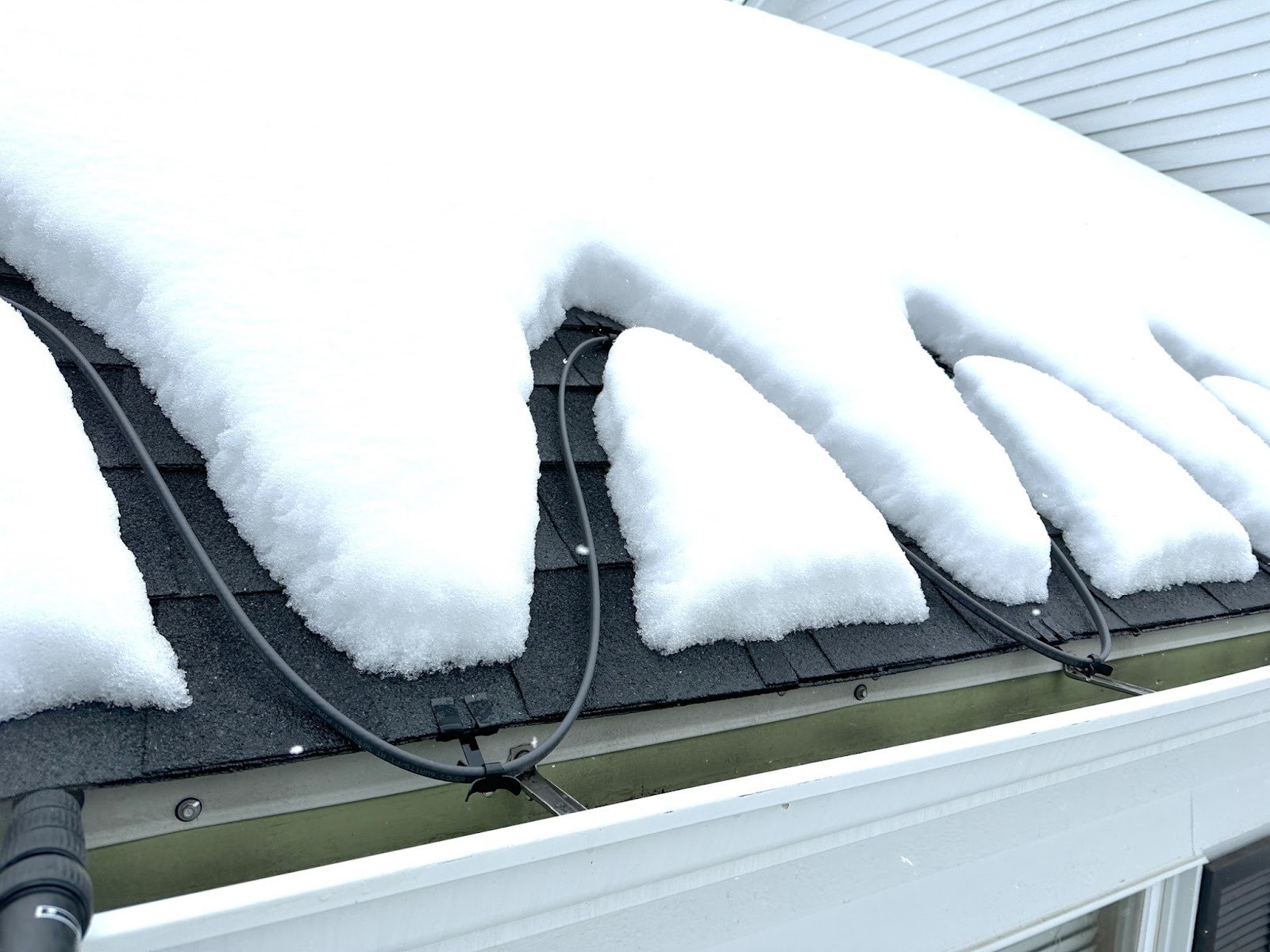
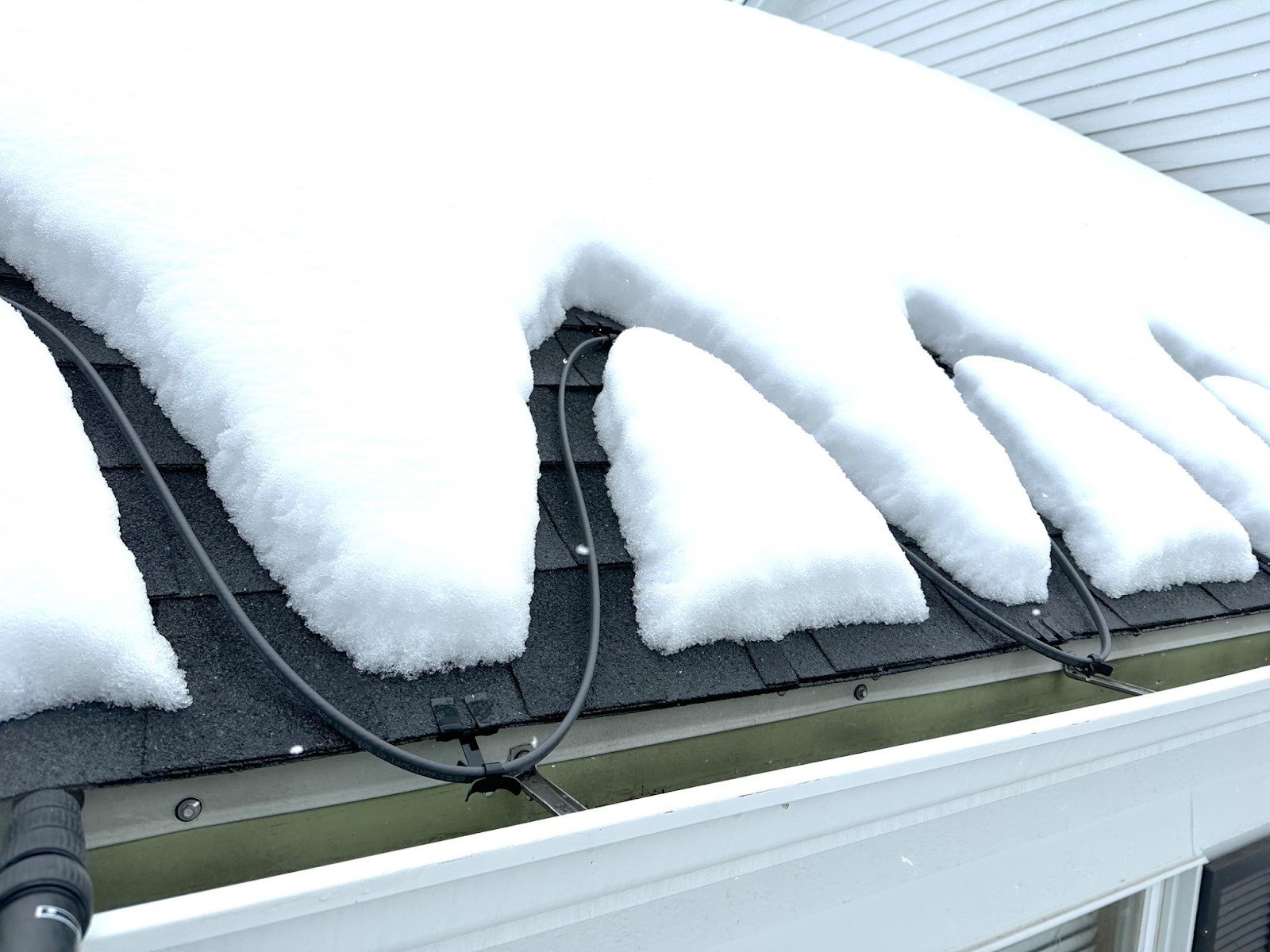
Heat cable does not melt the snow off a roof and is not meant to. It keeps a continuous drainage channel open from the roof surface, through the gutter, down the downspout and out at the bottom, so meltwater always has somewhere to go instead of pooling at a cold eave and refreezing into a dam.
That distinction matters when sizing a system. A cable run along the eave with nothing in the gutter or downspout simply moves the ice a few feet down. The path has to be continuous to the ground to work.

Self-regulating or constant-wattage cable?
Self-regulating cable is what belongs on a house. Its output rises as the surrounding temperature drops and falls as it warms, so it draws less power during a thaw and more during a deep freeze, and it cannot overheat where it overlaps itself.
| Type | Output | Notes |
|---|---|---|
| Self-regulating | Roughly 5–9 watts per foot at 50°F, rising as it gets colder | Safe where it overlaps, adjusts to conditions, longer service life |
| Constant wattage | Fixed output regardless of temperature | Can overheat at overlaps, cannot be cut to length in the field |
| Hardware-store kit | Fixed, usually undersized | Rarely reaches the downspout, which is where the system fails |
Where does the cable need to run on a Westerville roof?
Placement is decided by where meltwater actually travels on your specific roof, not by a standard pattern. On most homes that means:
- A zigzag along the eave, extending far enough up the slope to sit above the exterior wall line
- Through the gutter for the full run, not just at the ends
- Down each downspout and out past the discharge point
- Up any valley that drains onto the eave
- Around dormers, skylights and low-slope transitions where ice reliably forms
Neighbourhoods we are in most often: Uptown Westerville, Highlands, Annehurst, Sunbury Road corridor. It means the honest answer often lies in the attic, not on the roof surface.
Is heat cable a substitute for fixing the attic?
No, and it is worth being straight about that. Ice dams are caused by heat escaping through the ceiling into the attic, and the permanent fix is air sealing, insulation and ventilation. Cable manages the symptom.
It is still the right call in specific situations: complex roof geometry where dams form at a valley or dormer no matter how good the attic is, a cathedral ceiling with no attic to work in, a roof over a heated space that cannot be vented, or as protection during the winter before insulation work is scheduled. If your attic is the problem and it can be fixed, fix it first — ice dam prevention covers that work.
Heated Roof & Gutter Cables near Westerville — free estimate
Call (330) 918-1018 for a real arrival slot, or request a quote below. Written price before work starts, photographs of everything.
Free Westerville estimate
Tell us what you need and we call you back.
Other services in Westerville, OH
Back to Westerville services or all Ohio locations.
Heated Roof & Gutter Cables in other Ohio cities
- Heated Roof & Gutter Cables in Akron
- Heated Roof & Gutter Cables in Ashtabula
- Heated Roof & Gutter Cables in Aurora
- Heated Roof & Gutter Cables in Barberton
- Heated Roof & Gutter Cables in Brunswick
- Heated Roof & Gutter Cables in Canton
- Heated Roof & Gutter Cables in Chardon
- Heated Roof & Gutter Cables in Cleveland
- Heated Roof & Gutter Cables in Columbus
- Heated Roof & Gutter Cables in Cuyahoga Falls
- Heated Roof & Gutter Cables in Dublin
- Heated Roof & Gutter Cables in Elyria
- Heated Roof & Gutter Cables in Green
- Heated Roof & Gutter Cables in Hudson
- Heated Roof & Gutter Cables in Kent
- Heated Roof & Gutter Cables in Lakewood
- Heated Roof & Gutter Cables in Lorain
- Heated Roof & Gutter Cables in Massillon
- Heated Roof & Gutter Cables in Medina
- Heated Roof & Gutter Cables in Mentor
- Heated Roof & Gutter Cables in North Canton
- Heated Roof & Gutter Cables in Parma
- Heated Roof & Gutter Cables in Portage Lakes
- Heated Roof & Gutter Cables in Sandusky
- Heated Roof & Gutter Cables in Solon
- Heated Roof & Gutter Cables in Stow
- Heated Roof & Gutter Cables in Strongsville
- Heated Roof & Gutter Cables in Toledo
- Heated Roof & Gutter Cables in Twinsburg
- Heated Roof & Gutter Cables in Wadsworth
- Heated Roof & Gutter Cables in Warren
- Heated Roof & Gutter Cables in Wooster
- Heated Roof & Gutter Cables in Youngstown
Heated Roof & Gutter Cables in Westerville — common questions
When should cable be installed?
+
Before the first hard freeze. Installation needs a dry roof and workable temperatures, so autumn is the right window. Cable can be installed mid-winter in a pinch, but it costs more and the conditions are worse.
How much does it cost to run?
+
A self-regulating system draws roughly 5–9 watts per foot at 50°F and only when it is cold. Running it on a thermostat or controller rather than leaving it on all season is what keeps the operating cost sensible.
Will cable damage my shingles?
+
No. Cable is clipped rather than nailed or glued, and self-regulating cable cannot overheat at overlaps. It is fasteners driven through the roof surface that cause problems, which is why clips are used.
Do the cables need their own circuit?
+
Most installations do, and it must be a GFCI-protected circuit. That work is part of the quote rather than something left for you to arrange afterwards.
Can you install cable on a commercial building in Westerville?
+
Yes, including oversized gutter runs and long downspouts. Commercial systems are sized to the drainage the building actually needs.
Which areas do you cover from Westerville?
+
The Westerville dispatch covers Franklin County, plus surrounding addresses. Call (330) 918-1018 to confirm yours.
Need help in Westerville?
Free inspection, written price before work starts, and photographs of everything.
Call (330) 918-1018 Online QuoteFree Westerville Estimate
Takes about 20 seconds.