
Winter services
Heated roof & gutter cables
Here is the part the industry will not say plainly: heat cables do not stop ice dams. They melt relief channels through the ice so trapped water has somewhere to go — and that is what keeps water out of your house. A system working perfectly still leaves ice on your roof.

The honest version
Search this topic and you will find two confident, contradictory answers. Manufacturers and most contractors say heat cables prevent ice dams. Home inspectors and ice dam specialists say cables only melt relief channels through the snow and ice, and the dam stays where it is.
The second answer is the correct one, and it is the one we give customers before they buy. A heat cable's job is to open a drainage path so meltwater coming down the roof has somewhere to go instead of backing up under your shingles. It is not to clear your eave. With a properly working system you should still expect ice on your roof edge in February — and a dry ceiling underneath it.
What a standard cable actually does
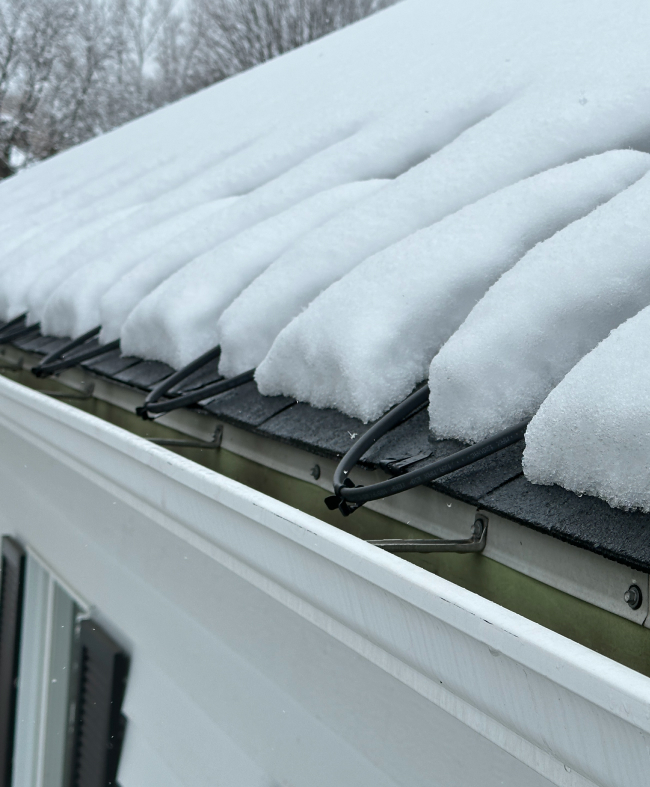
Electrical resistance warms the cable, the cable melts a narrow path through the snow and ice sitting on it, and meltwater coming down from higher up the roof runs through that path into the gutter and away. The ridge of ice on either side of the channel stays where it is.
That sounds like a compromise. It is not. Water trapped behind an ice dam is what gets under your shingle courses and into the ceiling. Give that water a way out and the dam becomes a cosmetic problem instead of a leak problem. A system that leaves ice on your eave but keeps your ceiling dry has done exactly what you paid for.
The reason this matters is expectation. Homeowners promised a clear roof edge look at their ice-covered eave in February and conclude the system failed, when it is working correctly.
The six-inch rule — the detail that decides whether it works
Ice dams start just above the top plate of your exterior wall. That is the line where the heated part of the house ends and the cold overhang begins, and that temperature change is what sets the whole cycle in motion.
To do anything, the cable has to extend at least six inches past that wall plane, so the melted pathway crosses the zone where ice actually originates. Cable that stops short of it lets ice form above the cable, and meltwater arriving from up the roof hits that ice with nowhere to go. The system is energised, it is warm, and it is useless.
This is the most common reason an installed system does not perform, and it is invisible from the ground. If you already have cable and still get leaks, this is the first thing to check.
Gutter cable alone is not a system
Cable sitting in the gutter warms the gutter metal and the ice touching it. It does nothing to the roof deck above the wall where the dam forms. Ice dams are a roof phenomenon — they happen whether or not a gutter is there.
Gutter and downspout runs are still necessary. If the roof cable opens a channel and the meltwater then hits a frozen gutter or a plugged downspout, it backs up and refreezes at the roof edge anyway. The roof, the gutter and the downspout have to be a continuous heated path to the ground. Skipping the downspout is the second most common failure we find.

What a working system looks like in February
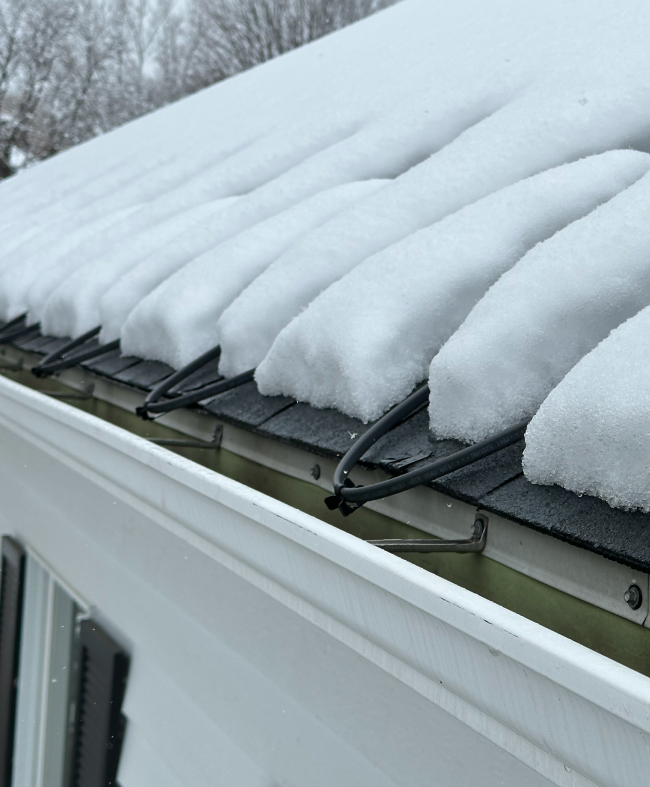
The cable does not clear your roof. It opens paths. From the ground, a correctly performing installation in the middle of winter looks like this:
- Ice still present along the eave, with visible melted channels running through it into the gutter
- Water coming out of the downspouts during a thaw instead of freezing at the roof edge
- Some icicles — usually fewer and smaller than before, not gone
- No water inside the house, which is the entire point
If a company promises a bare, ice-free roof edge from a cable installation, they are overselling it. Ask them to put that promise in writing and watch what happens.

How we install it
- We measure from the wall plane out, not from the gutter in, so the cable crosses the origin zone
- Roof, gutter and downspout are run as one continuous heated path to grade
- Self-regulating cable on almost every residential roof, so crossings cannot overheat and mild days cost less
- Temperature and moisture sensing so the system runs when conditions call for it, not all winter on a switch
- Clipped, never nailed or screwed through the roof covering, and never wedged under shingle courses
- Dedicated, properly protected circuit — not an extension cord to a porch outlet
Cable is not the fix. It is the workaround.
Ice dams are caused by heat escaping from your living space into the attic. Air sealing, insulation and working ventilation address the cause. Cable manages the symptom, permanently and at a running cost.
Cable is the right choice when the roof geometry makes the cause impractical to fix, when the attic work is scheduled but winter got there first, or as a second line of defence on a roof with a known history. It is the wrong choice when someone sells it to you instead of telling you your attic is the problem. We will tell you which situation you are in before we quote.
If you already have a dam on the roof right now, cable is not the answer this week — that is steam removal, and cable goes on afterwards.
Common questions
Do heat cables actually prevent ice dams?
No, and anyone telling you otherwise is overselling it. A heat cable melts narrow relief channels through the snow and ice so meltwater has somewhere to drain. That is what stops water backing up under your shingles and into the house. The dam itself largely stays put. Preventing the dam means fixing the heat loss in your attic, which is a different job entirely.
So why does everyone say cables prevent ice dams?
Because the marketing copy for the whole category got written around the strongest possible claim, and because the two things do look similar from the ground. If your cable is cutting drainage channels and no water is coming inside, the system is working exactly as designed even though the ice is still there. The problem is that homeowners who were promised a clear eave feel cheated by a system that is performing correctly.
What is the six-inch rule?
Ice dams originate just above the top plate of the exterior wall, where the heated part of the house ends and the cold overhang begins. For a cable to do anything useful it has to extend at least six inches past that wall plane, so the melted pathway crosses the origin zone. Cable that stops short of it lets ice form above the cable, and then meltwater has nowhere to go. This single measurement is the most common reason an installed system fails.
Will cable in the gutter alone fix my ice dams?
No. Ice dams form on the roof above the wall, not in the gutter. A cable sitting in the gutter warms the gutter metal and maybe the ice touching it, and does nothing to the roof deck where the dam actually starts. Gutter and downspout cable is necessary — it keeps the drainage path open all the way to the ground — but on its own it is not a system.
Is there a cable that stops ice from forming at all?
Not one we would sell you on that promise. Higher-wattage cable clears thicker ice faster and holds up better through extended subzero stretches, and it is the right specification on some roofs, but the job is still opening drainage paths rather than clearing the eave. If you want a roof edge that stays clear, the answer is upstairs: air sealing, insulation and ventilation so the snow stops melting from below in the first place.
Self-regulating or constant wattage?
Self-regulating cable varies its output with temperature, so it draws less power in mild conditions and more when it gets cold, and it will not overheat where cable crosses itself. Constant wattage cable puts out the same heat everywhere regardless. Self-regulating is the better choice on almost every residential roof; constant wattage is cheaper up front and needs more careful layout and controls.
Do they run all winter?
They should not. A proper installation uses a temperature and moisture sensor so the system energises only when it is both cold enough and wet enough to matter. Cable left running on a manual switch through the whole season is where the frightening electric bills come from.
Can I install heat cable myself?
Plug-in kits exist and people do install them. Two things go wrong. The layout is usually short of the origin zone, so the system does not work, and the power source is often an extension cord or an unprotected outlet, which is a fire and shock risk on a wet roof. Cable also has to be clipped so it does not chafe or trap debris under shingle edges.
Do cables damage the roof?
Properly clipped cable does not. Cable fastened with nails or screws through shingles does, and so does cable jammed under shingle courses where it holds debris and moisture. On an older or brittle roof, installation should be timed with a roof replacement where possible.
Are heat cables a substitute for fixing the attic?
No, and we will tell you that before we quote one. Ice dams are caused by heat escaping into the attic. Air sealing, insulation and working soffit-to-ridge ventilation address the cause; cable manages the symptom. Cable makes sense when the roof geometry makes the cause impractical to fix, when the fix is scheduled but winter arrives first, or as a belt-and-braces addition on a roof with a known history.
How long do they last?
A quality cable properly installed generally gives many winters of service. Cheap cable, sun exposure and poor clipping shorten that considerably. Warranty terms vary by product and are stated in writing on your proposal.
Where do you install these?
Across 29 states — every state where ice dams are a regular winter problem. Crews mobilise to wherever the work is. Roofing, gutters and siding are Ohio, Pennsylvania and New York only, where we hold contractor licences.
Where we work. Heated cable installation, ice dam removal and roof snow removal are offered across 29 states — Alaska, Colorado, Connecticut, Idaho, Illinois, Indiana, Iowa, Maine, Maryland, Massachusetts, Michigan, Minnesota, Montana, Nebraska, Nevada, New Hampshire, New Jersey, New York, North Dakota, Ohio, Pennsylvania, Rhode Island, South Dakota, Utah, Vermont, Washington, West Virginia, Wisconsin and Wyoming. Roofing, gutters, siding and insurance restoration are offered in Ohio, Pennsylvania and New York, where we are a licensed contractor. Related: heated roof cables, heated gutter cables, ice dam prevention, are roof heat cables worth it, and roof snow removal.
Get it specified properly
We will tell you which system your roof actually needs — and whether cable is the right answer at all.
Call (330) 918-1018