
Original research · August 2026
What ice dam removal really costs
We coded every price claim on every page ranking for this question. They do not agree with each other, and none of them can describe an emergency call. Then we published our own rates, which nobody else in this search result does.
The finding
We collected all 17 published price claims across the 8 publishers ranking for ice dam removal cost in August 2026 and coded each by the method it described. Published hourly rates span $100 to $900 an hour. Published typical job ranges span $125 to $2,400. Four of the eight publishers state the identical figure of $1,200 as the national average.
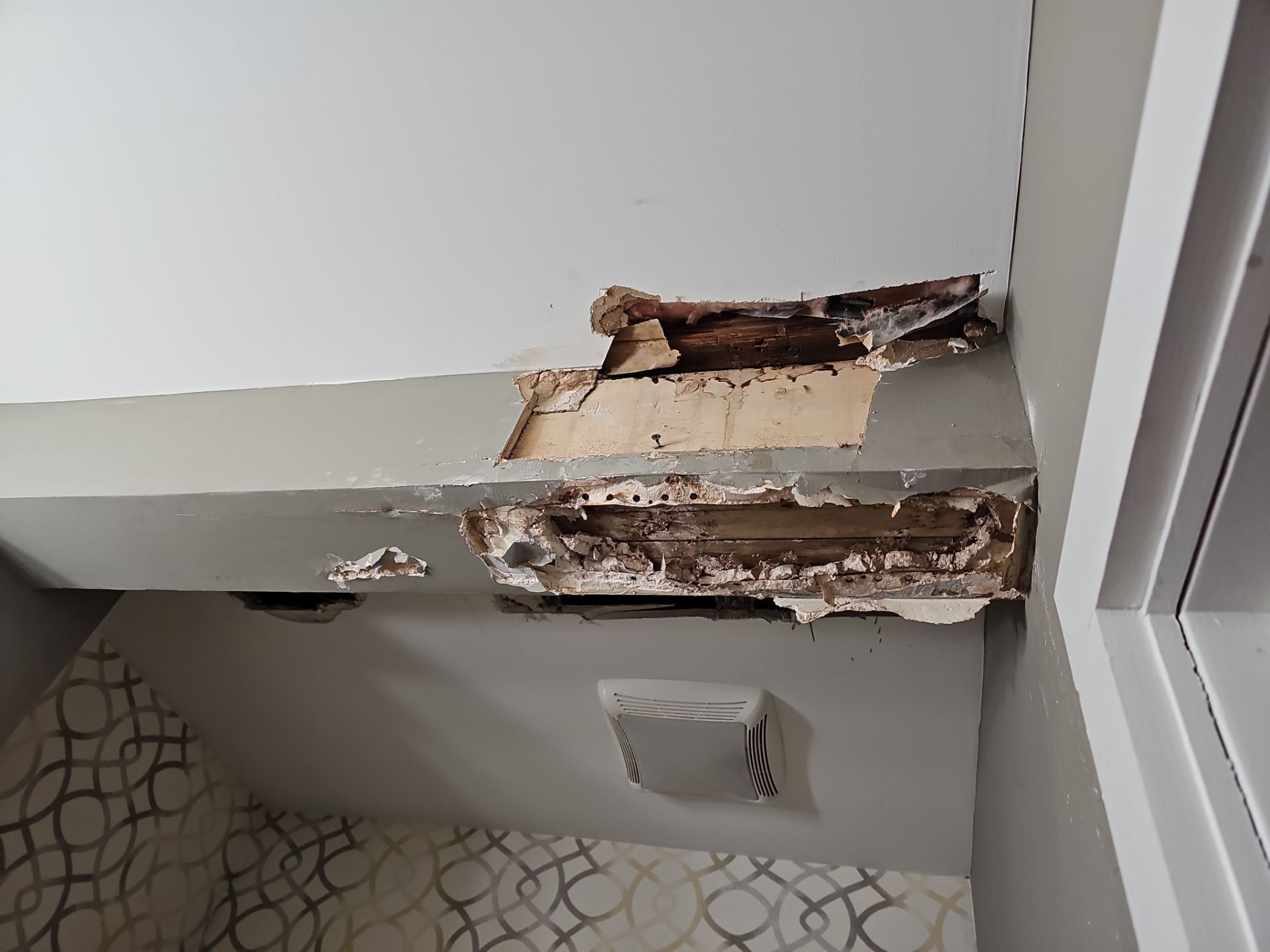
Here is what none of them can account for. Our own floor rate for a standard low-pitch roof is $875 an hour with a three hour minimum — $2,625, which is 2.2x the $1,200 average those four publishers agree on. A genuine emergency — ceiling coming down, water near electrical, crew pulled off other jobs and sent well outside the metro — runs $1,400 an hour or more on a four hour minimum, so $5,600 and up. That is 4.7x the published average and above the extreme tail of every range we coded. The aggregator numbers are not merely imprecise about emergency work. They do not reach it.
Method: every page ranking for “ice dam removal” and “ice dam removal cost” read in full, each stated price recorded with the method it described. Hand-coded, one afternoon, no cost. Raw dataset at the bottom of this page.
Our rates, published
Nobody else ranking for this keyword publishes a real number. We are going to, because the alternative is you finding out at the worst possible moment.
| Situation | Rate | What that means |
|---|---|---|
| Standard call Low-pitch roof, normal radius, scheduled | $875/hr | Three or four hour minimum depending on how booked we are. Starts at $2,625. This is our floor — we do not go below it. |
| Emergency call Active interior collapse, electrical risk, long drive, other jobs moved | $1,400+/hr | Four hour minimum. Starts at $5,600. Reflects displaced customers, distance, crew size and working conditions. |
The rate and the minimum that apply to your job go in writing before we start. If a claim is involved, that same figure is what goes to your carrier — we do not quote one number and submit another.
The spread, laid out
Every bar is one publisher's stated typical job range, on a common axis running to $6,000. The two orange bars are us. If these were all describing the same service, they would overlap.
The grey bars are a lead-generation network's city pages and, next to them, an explicitly labelled salt application — calcium chloride poured on the ice. Those city pages sit at or below the salt price in three of four cities we checked. They are titled “ice dam removal cost.” They are not pricing ice dam removal.
Why four sites all say $1,200
Angi, HomeAdvisor, Fixr and one contractor blog all publish $1,200 as the national average. That is not four independent measurements converging on a truth. Angi and HomeAdvisor share a parent company. Contractor blogs routinely cite the aggregators. What looks like consensus is one number being repeated.
The two companies in our set that do ice dam removal as a specialty publish hourly rates instead of job averages, and their rates — $400 to $800, and $700 to $900 — overlap each other and sit far above the aggregator math. Specialists price by the hour because that is how the work behaves.
Our $875 is the market rate, not a premium
This is the part worth being blunt about. The largest ice dam specialist in the country publishes $700 to $900 an hour as the going rate for professional steam removal, states plainly that a quote below roughly $700 an hour usually means an uninsured or inexperienced operator, and describes its own rates as sitting toward the higher end of that band. Other national specialists price comparably, with the same kind of escalation for emergency and hard-access work that we apply.
Our floor of $875 an hour sits inside that published band. We are not the expensive option in this trade — we are priced where competent, properly insured steam crews are priced everywhere. What makes the number look shocking is the $1,200 national average sitting at the top of the search results, which was never describing this service in the first place.
Competitor figures are taken from the specialists' own published pricing pages, checked August 2026. Companies change rates; check their current pages.
Why the price moves: our own season, measured
We said above that rates move with demand. Here is the evidence, from our own payment records for the 2025–26 winter.
Second finding — demand concentration
Across 815 payments totalling $1,391,241 between 2 December 2025 and 20 March 2026, 76.9% of the season's revenue landed in February alone. Tighter than that: 47.5% of the entire winter — nearly half — came through in a single 14-day window ending 17 February. The busiest single day produced $123,493 across 46 separate jobs.
That is what a weather-driven emergency trade actually looks like. It is not a season. It is a two-week window with three quiet months around it.
Method: full Stripe payment export for the 2025–26 winter, all statuses paid, no refunds. Totals include every service line, not ice dams alone. Rolling 14-day sums computed across the period.
Two things follow from this, and both cost you money if you ignore them.
- Everybody calls in the same fortnight. Every competent crew in the region is booked solid during that window. That is when rates are highest across the whole industry, and when you are least likely to get someone the same day.
- The cheapest call you will ever make is the one before the window. Ice at the eave in late January, with nothing coming inside yet, is a scheduled job at our floor rate. The same roof on 12 February with a ceiling coming down is an emergency call at more than double the hourly rate and a longer minimum.
We also charge a $500 deposit to hold a slot, with the balance on the card after the work is done, and financing through GreenSky is available on larger jobs. In the 2025–26 season we took 207 of those deposits, 192 of them in February. The median gap between deposit and final balance was one day — that is how compressed the window is. Median final balance was $2,538.
Why an emergency costs more per hour
This is counter-intuitive and worth saying plainly. When your ceiling is failing and there is water near electrical, the rate goes up, not down.
- Other customers get moved. People who booked ahead lose their slot. That has a cost and it is not fair to hide it.
- Distance. Emergencies do not wait for a crew already working three towns over, so someone drives.
- Conditions. Active interior water, compromised ceilings and electrical risk mean more crew, slower work and more care.
- Time of day. The call rarely comes at ten in the morning on a Tuesday.
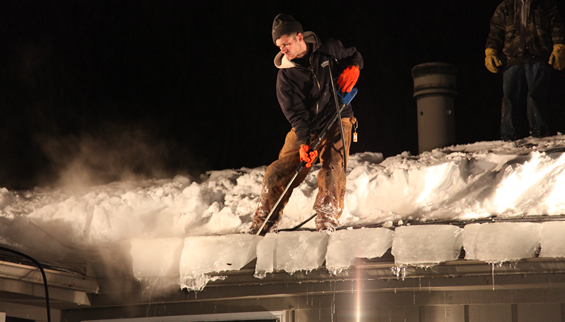
We run crews around the clock during storm events. If your ceiling starts coming down at one in the morning, that is a call we have taken and will take again — and the rate reflects waking a crew and putting them on an icy roof in the dark. Most companies in this trade will book you for the following afternoon instead. Whether that is worth the difference depends entirely on whether water is moving through your ceiling right now.
That is exactly the scenario where the money is most likely to be recoverable, because a genuinely active leak is the one situation where removal can be argued as mitigation of an ongoing loss rather than maintenance. A $5,600 emergency you get partly reimbursed on can end up costing less than a $2,625 scheduled call you pay entirely yourself.
That is the whole reason we treat the paperwork as seriously as the steam. See ice dams and insurance claims for what has to be documented and when. We build and submit the package. We do not guarantee the outcome.
What to ask before you compare quotes
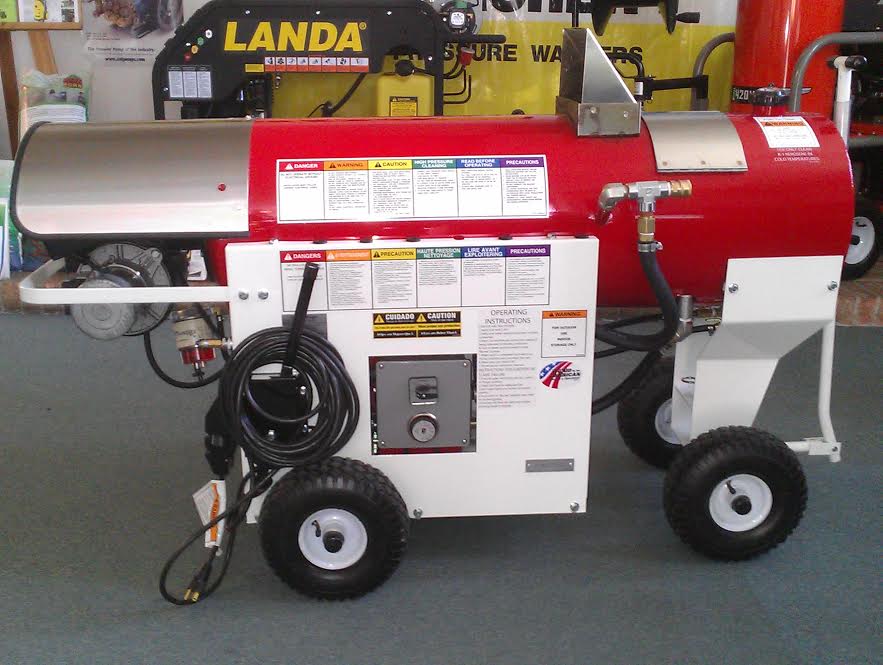
Plenty of companies advertise steam and arrive with a hot-water pressure washer. Pressure — even warm pressure — lifts and cracks shingles and can void your manufacturer warranty, so a cheaper quote for pressure washing is not a cheaper quote for the same service.
You will see a shortcut repeated online: true steamers run an open wand with continuous flow, pressure washers have a trigger. It is a reasonable opening question, but it is genuinely disputed within the trade and at least one major operator argues the trigger alone does not tell you what machine you are looking at. So ask better questions instead:
- What machine are you bringing, by make and model?
- What temperature does it run at, and is it a steamer or a hot-water pressure washer?
- Are you insured specifically for ice dam removal, and will you send the certificate?
- What is your hourly rate and your minimum, in writing, before you arrive?
A company that answers all four plainly is usually the right company.
What actually moves your number
- Ice volume. A twelve-foot dam four inches thick and a forty-foot dam a foot thick are not the same job.
- Snow above the dam. It often has to come off first, which is billable roof snow removal time before the steamer starts.
- Roof height and pitch. Our floor rate assumes a low-pitch roof. Steep and two-story access means more setup and slower work.
- Gutter guards. They block steam access to the ice underneath and add time.
- Demand that week. Nearly half our season's work arrives in one 14-day window. Those are the most expensive days of the year to call anyone, us included.
- Distance from our base. A rural call two counties out carries cost a suburban call does not.
When we tell you not to spend it
We wrote a whole page on this: ice dam formed but no leak yet walks through how to judge whether yours needs attention today.
At $2,625 as a floor, we would rather talk you out of an unnecessary call than take it. If you have ice at the eave, nothing coming inside, a south-facing slope and a thaw in the forecast, waiting is often correct. Describe it on the phone and we will say so.
Common questions
What is your ice dam removal rate?
Our floor is $875 an hour with a three or four hour minimum depending on how booked the schedule is, for a standard low-pitch roof within our normal service radius. That is the lowest number we charge, so a straightforward job starts at $2,625. Emergency calls that require moving other customers, long drives outside the metro, or work on a house with an actively collapsing ceiling run $1,400 an hour or more with a four hour minimum. You get the rate and the minimum in writing before we start.
Why is that so much higher than the $1,200 average I read online?
Because the $1,200 figure is not describing this service. Cost-aggregator pages blend salt applications, roof raking, chipping and steam work into one average, and four of the eight publishers we coded repeat the identical $1,200 number. A true steam crew, insured for this specific work, running commercial equipment in freezing conditions on a two-story roof, does not cost what a bag of calcium chloride costs. The published averages are not wrong about salt. They are wrong about steam.
Why does a real emergency cost more per hour, not less?
Because an emergency call is not the same job. If your ceiling is coming down and there is water near electrical, we are moving other customers who booked ahead, dispatching outside our normal radius, and working under conditions that require more crew and more care. That is what pushes the rate to $1,400 an hour and above. It is also precisely the situation where the cost is most likely to be reimbursable, which is why the insurance side matters so much on emergency calls.
Is a $200 ice dam removal real?
It can be real, but it is almost certainly not steam removal. At that price you are buying a salt application or a roof rake visit. Those are legitimate for a small dam or as a stopgap, but they will not remove an established ice dam, and salt applied directly to roofing can damage shingles and the plantings below.
Will insurance pay for this?
Sometimes, and it is worth pursuing at these numbers. Most carriers exclude removal as maintenance and cover only the resulting interior damage. Where there is an active leak, removal can qualify as mitigation of an ongoing loss. We build and submit the documentation package that supports that argument. We cannot guarantee an outcome, and anyone who tells you they can is not being straight with you.
Does the price go up during a storm?
Yes, across the industry. Demand spikes in the days after a heavy snow followed by a freeze, and crews are working longer drives in worse conditions. Booking before your dam starts leaking is almost always cheaper than booking after.
Why a three or four hour minimum?
Because mobilisation is most of the fixed cost. Getting a truck, a steamer, ladders and a crew to your house and set up safely on ice takes the same effort whether the dam is ten feet or forty. The minimum flexes between three and four hours depending on how booked we are, and we tell you which applies when you call.
How long does a removal job actually take?
Most residential jobs run two to four hours of steam time. A crew with a real steamer clears roughly ten to fifteen feet of dam per hour, though ice thickness, roof height, pitch and the amount of snow that has to come off first move that considerably.
Will it come back, and will I pay again?
If the weather pattern repeats and the snow above the dam is not managed, it can reform in the same spot within one to two weeks. At these rates, that is the strongest possible argument for fixing the attic heat loss rather than budgeting for repeat removals. We will tell you what is causing it.
Do gutter guards make removal more expensive?
Yes, usually. They block a steamer's access to the ice underneath, which means more billable time on the same dam.
Should I get multiple quotes?
Get at least two, and compare method before price. Ask whether the wand has a trigger. If it does, it is a pressure washer rather than a steamer, and a cheaper quote for pressure washing is not a better deal on the same service.
When should I not spend the money?
If you have ice at the eave, nothing coming inside, a south-facing slope and a thaw in the forecast, waiting is often the right call. Tell us that on the phone and we will say so.
Are you more expensive than the national ice dam companies?
No. The largest national specialist publishes $700 to $900 an hour as the going rate and describes its own pricing as toward the top of that band. Our $875 floor sits inside it. Comparable national operators price similarly and escalate the same way for emergency and difficult-access work. Where we differ from the search results is that the aggregator sites quoting a $1,200 average are not pricing steam removal at all.
Do you actually answer at 1am?
Yes, during storm events. We run crews around the clock, and we have dispatched in the middle of the night for active interior collapses. That work is priced at the emergency tier because it means waking a crew and working an icy roof in the dark. If the situation can safely hold until morning, we will tell you and book you for morning. Full scope on the ice dam removal service page.
Where we work. Ice dam removal and roof snow removal are offered across 29 states — Alaska, Colorado, Connecticut, Idaho, Illinois, Indiana, Iowa, Maine, Maryland, Massachusetts, Michigan, Minnesota, Montana, Nebraska, Nevada, New Hampshire, New Jersey, New York, North Dakota, Ohio, Pennsylvania, Rhode Island, South Dakota, Utah, Vermont, Washington, West Virginia, Wisconsin and Wyoming. Rates reflect crew mobilisation and distance, which is why a call far from an active storm market prices differently.
Dataset. The 17 coded price claims, with source, URL, publication date and described method, are available as a CSV on request — email info@roofgutternow.com. Figures were current as of August 2026 and publishers update them, so check the source pages for current numbers.
Our rates are current as of the date of this page and are subject to change with conditions and season. The rate and minimum applicable to your job are confirmed in writing before work begins. Coverage discussion on this page is general information, not insurance advice — read your policy and speak with your carrier or agent.
Get the real number for your roof
Rate and minimum in writing before we start. Same-day and next-day scheduling during storm events.
Call (330) 918-1018