
Insurance Claims & Adjuster Disputes
The Repairability Test: Proving a Patch Will Destroy the Roof
The brittleness test shows whether damaged shingles can be replaced without breaking the surrounding field. When they cannot, the repair is not a repair — it is a slope replacement.
Written by Nathaniel Davis, owner of Roof Gutter Now — a licensed exterior restoration contractor in Ohio, Pennsylvania and New York. Updated August 2026
Carriers approve spot repairs on the assumption that a damaged shingle can be lifted out and swapped. On an aged roof that assumption often fails, and the test that proves it takes about a minute.
How the test is performed
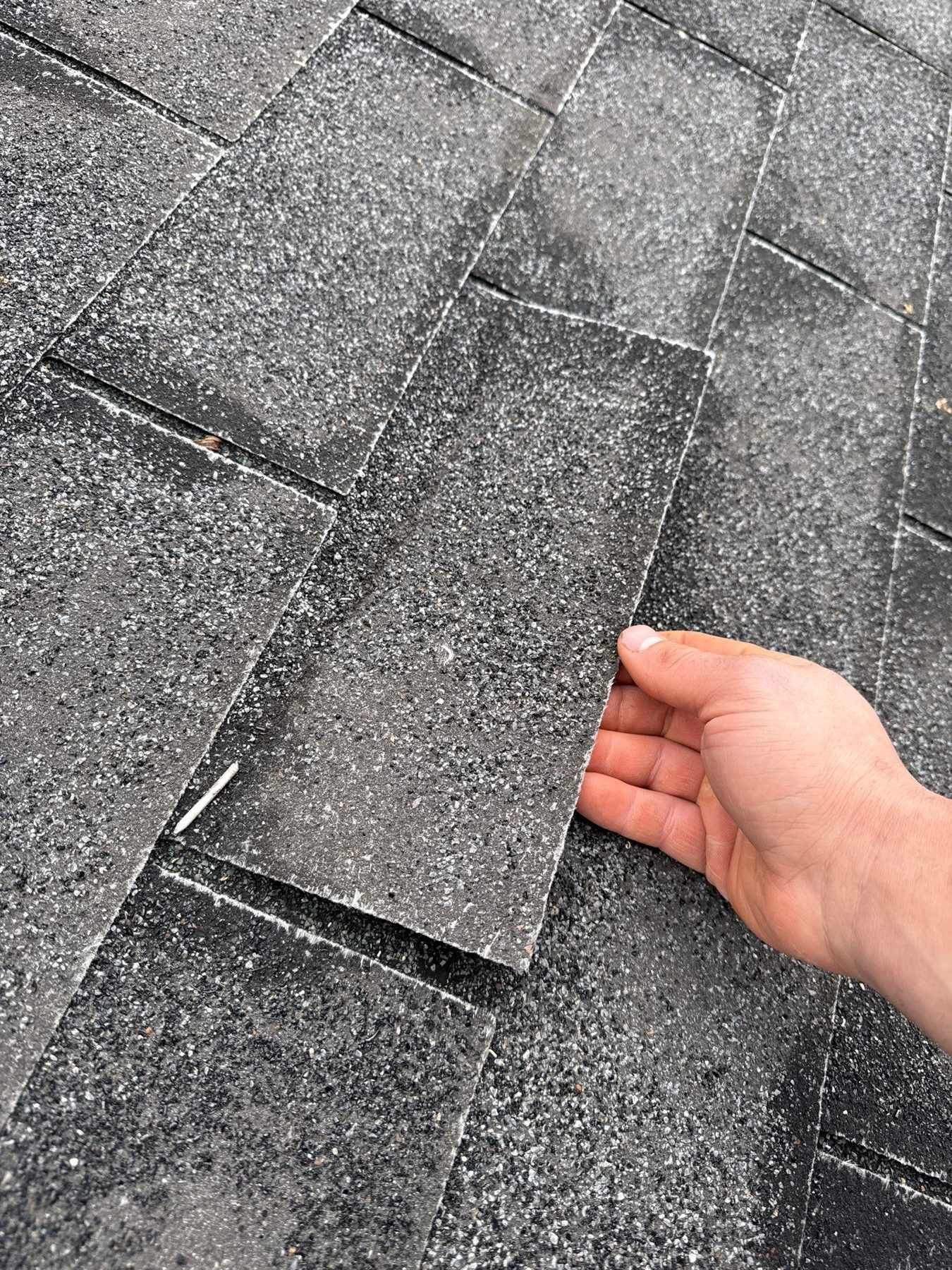
Pick an undamaged shingle adjacent to the damage. Break the sealant bond by hand and lift the tab through roughly a 90-degree arc, the same movement required to expose the nail line of the course below. Do it at ambient temperature, not on a hot afternoon when asphalt is pliable.
If the tab cracks, tears at the nail line or leaves the mat delaminated, the roof fails the test. You cannot access the fasteners of the damaged course without destroying the courses around it.
Why this decides the scope
Replacing a shingle means lifting the two courses above it to reach the nails. If those courses break on contact, every repair attempt creates new damage, and the crew is chasing failures up the slope. That is not a repair — it is a partial tear-off performed badly.
Document it with video, not stills. A carrier can dispute a photograph of a cracked tab. Video of three consecutive test lifts producing three fractures is much harder to argue with.
Pairing it with the matching problem
Brittleness and discontinuation usually travel together. A roof old enough to fail a lift test is usually old enough that the exact shingle is no longer produced. Run the ITEL analysis at the same time, so the file carries both arguments: the repair cannot be executed, and the material cannot be matched.
Common questions
What temperature should the test be done at?
+
Ambient, in the shade if possible. Warm asphalt flexes and will pass a test that the same roof fails at 45°F, which is closer to the condition a repair crew would actually work in.
How many shingles should be tested?
+
At least three, on separate slopes. One cracked tab is an anecdote; a consistent result across elevations is a roof condition.
Does failing the test guarantee a full replacement?
+
No. It establishes that spot repair is not viable on that slope. What the carrier then approves depends on the policy and the extent of storm damage.
More on Insurance Claims & Adjuster Disputes
- Why Adjusters Call Creased Shingles “Mechanical Damage”
- Overhead & Profit: Triggering the Three-Trade Requirement
- Xactimate RFG DRIP vs RFG DRIP+: Why the Code Changes Your Payout
- Ordinance & Law Coverage: Getting Drip Edge and Ice Barrier Paid
- Reading a Summary of Loss: RCV, ACV and the Net Claim Trap
- The Cosmetic Damage Exclusion: When Metal Roof Dents Get Denied
See Insurance Claims services or find your local crew.
Need this looked at?
Free inspection, photographs of every finding, and a written scope before any work starts.
Call (330) 918-1018