
Insurance Claims & Adjuster Disputes
Why Adjusters Call Creased Shingles “Mechanical Damage”
Adjusters label wind-creased shingles as mechanical damage to shift the cause from the storm to foot traffic or installation. Here is how the crease itself disproves that.
Written by Nathaniel Davis, owner of Roof Gutter Now — a licensed exterior restoration contractor in Ohio, Pennsylvania and New York. Updated August 2026
What a wind crease actually looks like
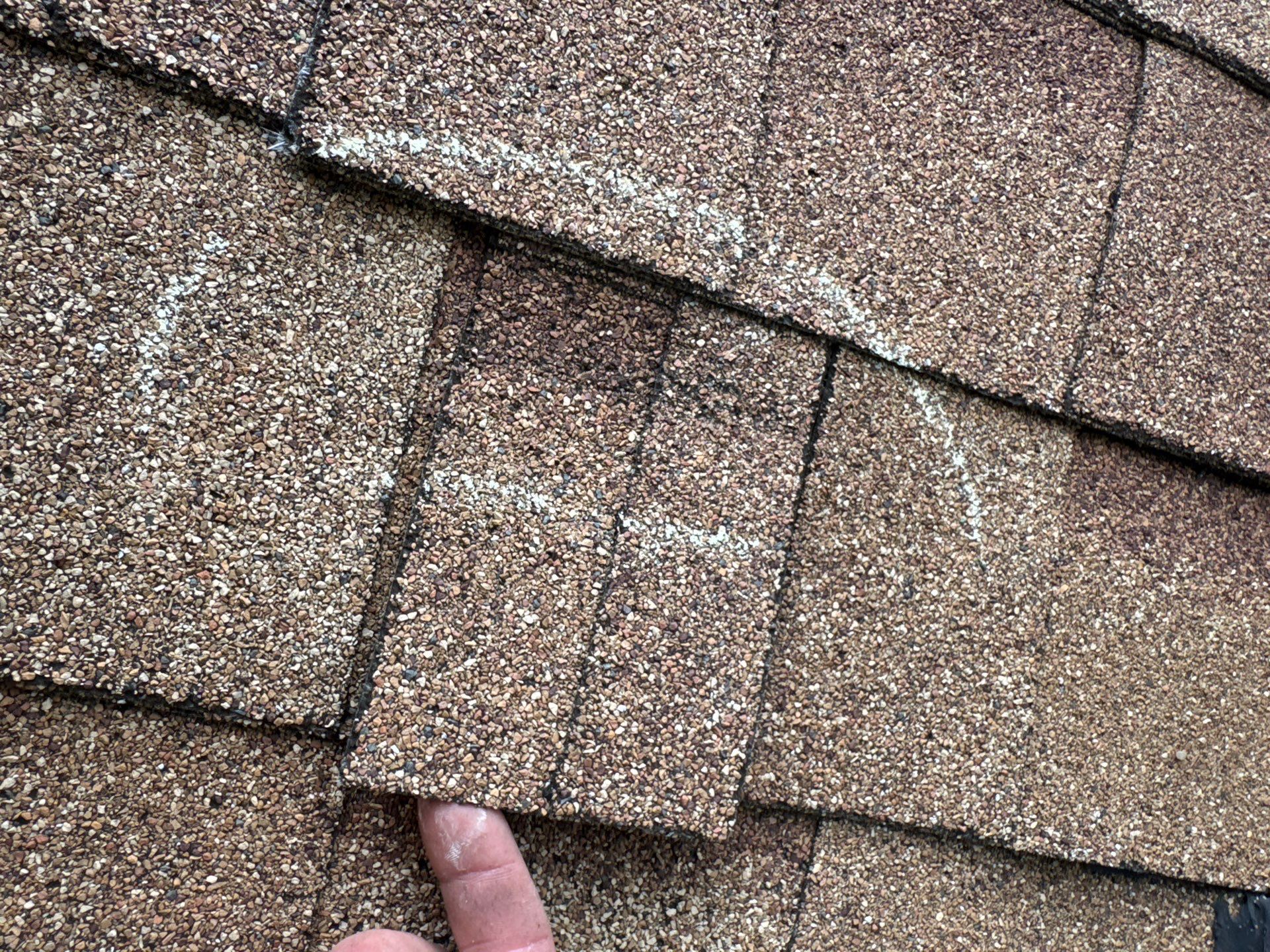
Wind damage creases run horizontally across the tab, roughly parallel to the butt edge, at the point where the sealant strip released. The mat is fractured even when the shingle lies flat again. Lift it and the crease line stays.
Foot traffic damage looks different. It leaves scuffing, granule displacement in a boot-shaped pattern, and cracks that radiate rather than run in a straight line. It also clusters near the ridge, the access point and the penetrations — not along the rake and eave where wind uplift is highest.
The three things that disprove the mechanical label
- Location pattern. Wind damage concentrates on the elevations facing the storm and along the rake edges. Map the creased tabs on all slopes. A storm pattern is directional; foot traffic is not.
- Sealant strip condition. Photograph the underside. A wind-lifted shingle shows a clean release across the full strip. A shingle stepped on shows an intact bond with a crack through it.
- Corroborating soft metal. If the same elevation shows dented gutter aprons, bent vent caps or scoured window wraps, the wind event is documented independently of the shingles.
How to submit it so it sticks
Photograph each creased shingle twice — once flat, once lifted — with a marker or chalk arrow at the crease line. Include a slope diagram showing which elevations carry damage. Reference the NOAA storm report for the date of loss and the recorded gust speed at the nearest station.
Then ask the carrier the question directly in writing: if this is mechanical, what mechanism produced a directional pattern across three elevations? An adjuster who cannot answer that usually reinspects.
Common questions
Does a creased shingle actually fail?
+
Yes. The mat is fractured, so the shingle has lost tensile strength at that line and will separate in the next uplift event. It does not need to be missing to be damaged.
Can a roofer cause creasing while walking the roof?
+
It can happen in cold weather when asphalt is brittle, but it produces a different pattern — localized, near access points, with scuffing. That is exactly why the mapping matters.
What if the adjuster still denies it?
+
Request a re-inspection in writing with your photo set attached, and ask for the denial basis in writing. If the carrier holds, appraisal is the next route.
More on Insurance Claims & Adjuster Disputes
- The Repairability Test: Proving a Patch Will Destroy the Roof
- Overhead & Profit: Triggering the Three-Trade Requirement
- Xactimate RFG DRIP vs RFG DRIP+: Why the Code Changes Your Payout
- Ordinance & Law Coverage: Getting Drip Edge and Ice Barrier Paid
- Reading a Summary of Loss: RCV, ACV and the Net Claim Trap
- The Cosmetic Damage Exclusion: When Metal Roof Dents Get Denied
See Insurance Claims services or find your local crew.
Need this looked at?
Free inspection, photographs of every finding, and a written scope before any work starts.
Call (330) 918-1018