Cement, sand and cellulose pressed into boards that laugh at hail, ignore insects, don’t burn, and wear paint like furniture — the premium siding that earns its price in decades.
Fiber Cement Siding done properly comes down to components most quotes never mention: window flashing, fastener spacing and the butt joints. We inspect each before pricing, photograph what we find, and put the scope in writing so you see exactly what you're paying for. Licensed and insured across Ohio, Pennsylvania and New York.
Water damage gets worse every hour — call nowFiber Cement Siding — priced in writing before we start, no obligation.
Fiber cement resists impact, insects and fire, holds paint far longer than wood, and will not melt or warp from reflected heat. It is considerably heavier than vinyl and requires cutting and fastening methods suited to the material. Correct clearance at grade and at roof lines is critical, since the board absorbs water at cut edges. Related: board & batten siding and cedar siding installation & repair.

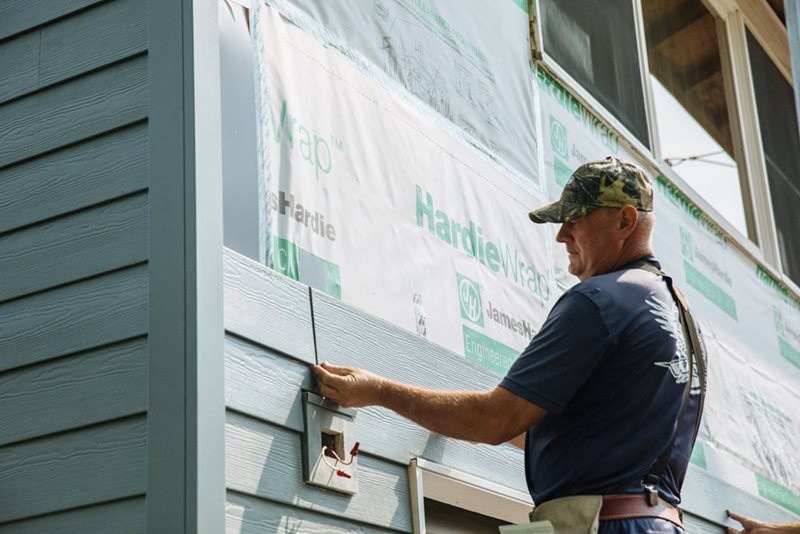
Fiber cement doesn’t dent like aluminum, crack like cold vinyl, rot like wood, or feed anything that chews — and it holds paint for years because the substrate never moves much. James Hardie defines the category with baked-on ColorPlus finishes and profile ranges from lap to shake to the board-and-batten above; equivalent lines exist and we’ll compare them straight. In hail country, its impact story alone converts a lot of storm-claim customers permanently.
Fiber cement is unforgiving of shortcuts: it’s heavy, cuts with dust controls, and demands the manufacturer’s clearances — off roofs, off grade, off flashing — plus flashed butt joints and the right fasteners, or the warranty walks. We install to the spec sheet because that’s where the decades come from, over wrap and flashing built to match the product’s ambitions.
If you value the painted-wood look, impact resistance, and a re-paintable future — usually yes on a long hold. Shorter horizons often favor premium vinyl; we quote both without attitude.
Factory finishes run long warranties; field paint cycles are far longer than wood because the board barely moves. Repaint-ability is a feature, not a chore schedule.
Excellently when clearances and flashing are right — moisture management is the spec, which is why installation discipline is the whole conversation.
For long holds where the painted-wood look, impact resistance and repaintability matter — usually yes. Shorter horizons often favor premium vinyl; we quote both straight.
Properly installed with correct clearances and flashing, it handles freeze-thaw excellently — moisture management is the spec, and the spec is the job.
Factory ColorPlus finishes arrive done and warrantied long; primed boards take field paint that lasts far longer than on wood because the substrate barely moves.
It’s heavy for installers, not for structures — standard framing carries it fine. The weight cost is in labor, which is priced into honest quotes.
It ends both conversations — there’s nothing in a cement board for anything to eat or excavate.
The exterior works as one assembly — these are the pieces that connect to this one.
Board and batten is a vertical pattern of wide boards with…
Learn more →Cedar needs periodic refinishing, typically every three to seven years depending…
Learn more →Behind the visible panel is a weather-resistive barrier, properly integrated flashing…
Learn more →Individual panels can be swapped when the product is still manufactured…
Learn more →Replacement makes sense when damage spans multiple elevations, when panels have…
Learn more →Vinyl expands and contracts significantly with temperature, so panels are nailed…
Learn more →Fiber Cement Siding is available across our licensed service territory in Ohio, Pennsylvania and New York. Find your city below, or call (330) 918-1018.
Free consult with samples — Hardie-class quotes, spec-sheet installation.
Takes about 20 seconds.
