When a claim rebuilds your roof, it must be rebuilt to today’s code — and ordinance & law coverage exists to pay the difference. These are the line items that vanish from fast estimates.
Before we price Code Upgrade Claims, we look at depreciation, line-item pricing and material match testing — the details that decide how long the work holds. You get a photographed assessment and a written scope with no obligation, and if the cause traces to a storm we document it for your carrier. Licensed and insured in Ohio, Pennsylvania and New York.
Water damage gets worse every hour — call nowCode Upgrade Claims — priced in writing before we start, no obligation.
Also called ordinance or law coverage, it pays for bringing repairs up to current building code even when the original assembly predates that code. Ice barrier at eaves, drip edge and deck fastening requirements are frequent examples. Because the code requirement is objective, these items are among the more straightforward supplement arguments. Related: matching siding & roofing claims and insurance supplements.

Your 2005 roof was legal in 2005. Rebuild it today and the residential code requires things it never had: ice barrier membrane at the eaves in our climate zone, metal drip edge at eaves and rakes, ventilation minimums, fastening schedules. Ordinance & law coverage — standard in most homeowner policies — exists precisely to fund code-driven differences on covered losses. The requirements themselves live in the residential code (ICC published codes, adopted with Ohio amendments); we cite chapter and section on every line.
Estimating software prices what the adjuster clicks — and code items don’t add themselves. An estimate showing shingles-and-felt with no ice barrier line in Northeast Ohio isn’t a judgment call; it’s an omission, and it’s one of the most common supplement items we file. Decking that can’t serve as a sound fastening surface gets the same treatment: documented at tear-off, cited, claimed.



The policy section funding code-required differences when rebuilding after a covered loss — typically a percentage of dwelling coverage. Most policies include it; we verify yours before claiming against it.
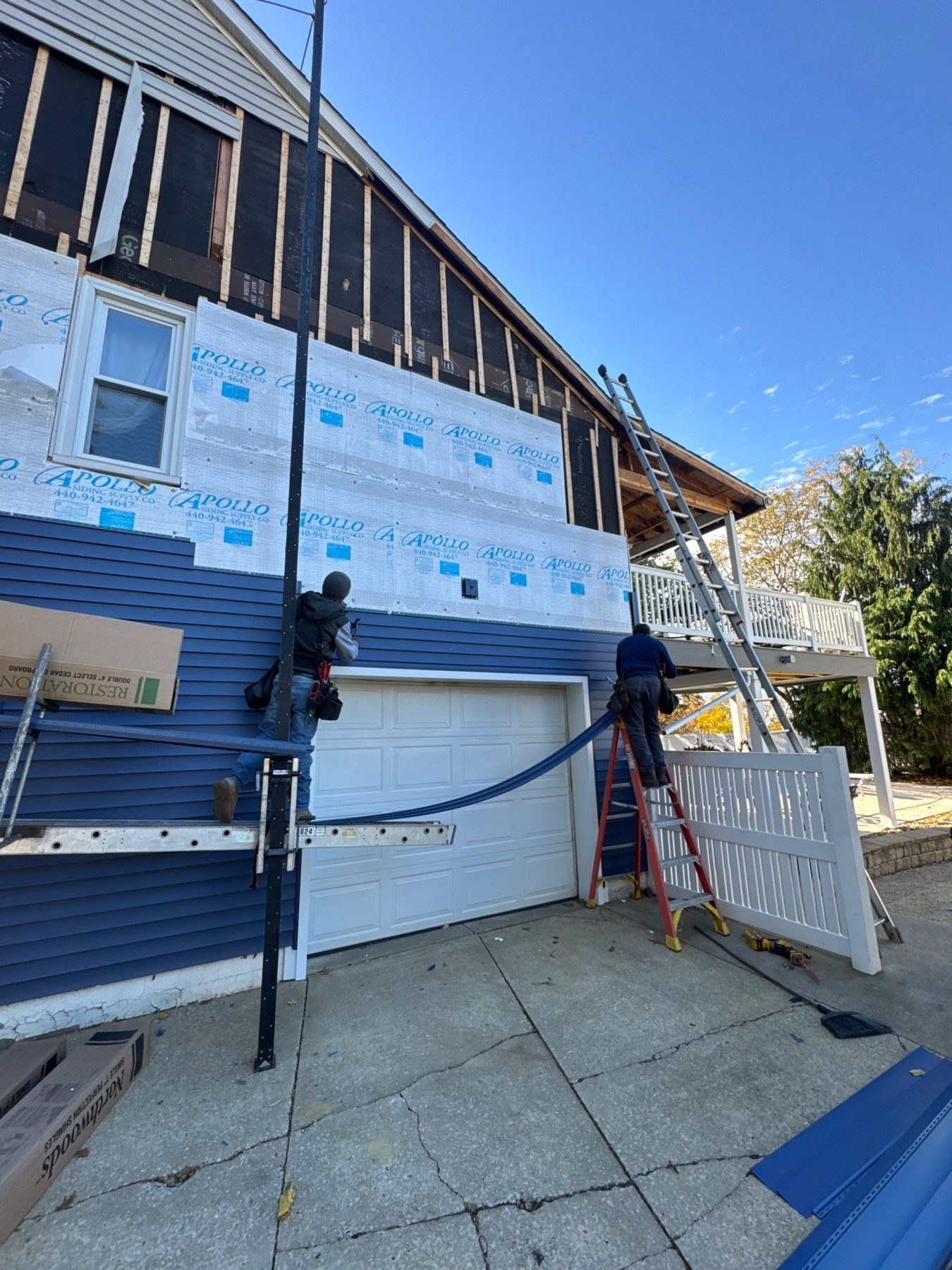
Ice and water barrier at eaves, drip edge, and ventilation corrections — in that order. On siding claims: house wrap requirements.
Yes — that’s standard supplement territory, strongest when documented before or during the work.
Helpfully, yes: the permit inspection enforces the same code we’re citing, which makes the carrier’s obligation concrete. We pull permits on every claim job.
The policy section funding code-required differences when rebuilding after a covered loss — typically a percentage of dwelling coverage, present in most policies, used in few.
Where current code requires them and the old roof lacked them — yes, under ordinance and law. They’re the most-skipped compensable items we supplement.
Your declarations page lists it, typically as a percentage of dwelling coverage — we read it during the free policy review before claiming against it.
Nearly always for replacement — and helpfully so: the permit inspection enforces the very code items ordinance-and-law coverage pays for.
The exterior works as one assembly — these are the pieces that connect to this one.
When damaged material cannot be matched, the question becomes what the…
Learn more →A supplement is a request to revise an approved claim when…
Learn more →A denial is a position, not a final outcome.
Learn more →Gutters damaged by a covered event are generally part of the…
Learn more →Hail damage on asphalt appears as random soft-bruise impacts with granule…
Learn more →Many policies cover water damage resulting from ice dams, including interior…
Learn more →Code Upgrade Claims is available across our licensed service territory in Ohio, Pennsylvania and New York. Find your city below, or call (330) 918-1018.
Free estimate audit for missing code items — citations included.
Takes about 20 seconds.
