
Insurance Claims & Adjuster Disputes
Granule Loss on Architectural Shingles: Failure, Not Aging
Carriers attribute hail granule loss to normal weathering. The distinction is whether the mat is exposed and whether the loss pattern matches an impact event.
Written by Nathaniel Davis, owner of Roof Gutter Now — a licensed exterior restoration contractor in Ohio, Pennsylvania and New York. Updated August 2026
Granules are the shingle’s UV protection. Losing them to hail is not cosmetic wear — it starts the clock on mat degradation, and the pattern tells you which cause is in play.
Impact loss versus weathering
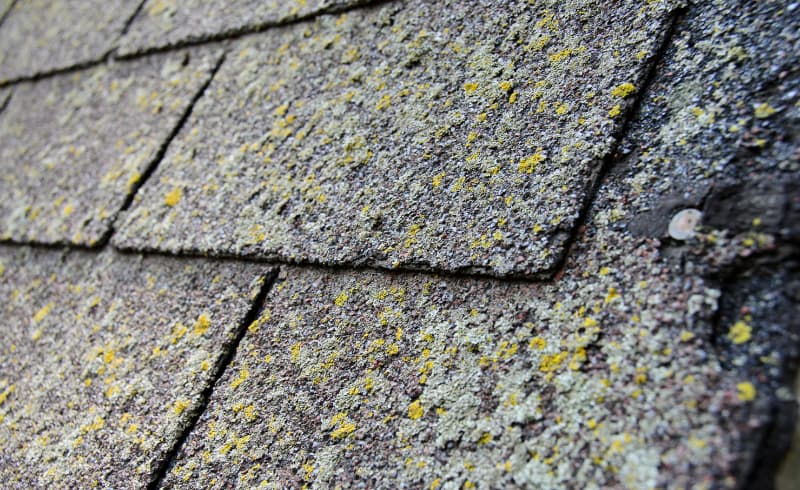
Weathering is gradual and even, heaviest in the water paths below valleys and around drip lines. It leaves no sharp edges.
Impact loss is circular, randomly distributed across the slope, with a defined edge and often a visible bruise where the mat is fractured beneath. Press it: a hail bruise gives, like a soft spot in fruit.
Documenting it properly
Chalk a 10x10 test square on each elevation. Circle and count the hits. Photograph the square as a whole and then individual strikes with a coin or gauge for scale. Check the downspout outlets for accumulated granules and photograph that too.
Then corroborate on soft metals from the same elevations — gutter aprons, vent caps, window wraps, A/C fins. Soft metal dents date the event independently of the shingles, which is what separates storm damage from age.
Common questions
How big does hail have to be?
+
Roughly one inch and up will commonly bruise an asphalt shingle, though older and thinner products fail at less.
Does granule loss always mean replacement?
+
No. It means the shingle is compromised where it occurred. Extent and distribution decide the scope.
What if the roof is already old?
+
Age affects depreciation, not causation. A storm can damage an old roof, and the two questions are answered separately.
More on Insurance Claims & Adjuster Disputes
- Why Adjusters Call Creased Shingles “Mechanical Damage”
- The Repairability Test: Proving a Patch Will Destroy the Roof
- Overhead & Profit: Triggering the Three-Trade Requirement
- Xactimate RFG DRIP vs RFG DRIP+: Why the Code Changes Your Payout
- Ordinance & Law Coverage: Getting Drip Edge and Ice Barrier Paid
- Reading a Summary of Loss: RCV, ACV and the Net Claim Trap
See Insurance Claims services or find your local crew.
Need this looked at?
Free inspection, photographs of every finding, and a written scope before any work starts.
Call (330) 918-1018