

Quick answer
What qualifies as hail damage, what gets dismissed as wear, and how a test square works. Free documented inspection in OH, PA & NY: (330) 918-1018.
Hail claims are won or lost on evidence gathered at roof level. An adjuster arrives looking for specific, verifiable indicators — and equally for reasons the damage might be something other than hail. Related: hail damage claims.
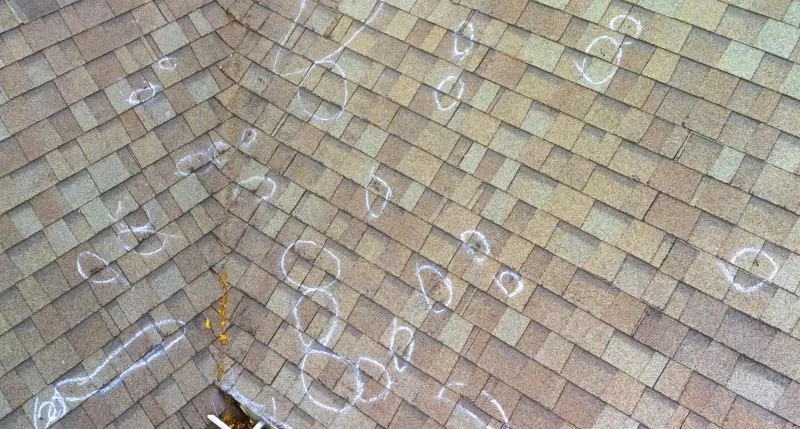
What Qualifies as Hail Damage
The signature is a bruise: a soft, dark, roughly circular spot where the impact fractured the mat beneath and dislodged granules. It feels soft under a thumb, like a bruise on fruit. Random distribution matters — hail does not fall in lines or patterns. Supporting evidence comes from soft metals: dents on gutters, downspouts, vents, flashing, air-conditioner fins and mailboxes all corroborate that hail of a damaging size fell.
What is not hail damage: blistering (round but hard, from manufacturing or heat), granule loss in traffic patterns, mechanical scuffs in straight lines, and normal ageing wear.

The Test Square
Adjusters typically mark a ten-by-ten-foot test square on each slope and count qualifying impacts inside it. Carriers set their own threshold, commonly somewhere around eight to ten hits per square, above which the slope is considered damaged. This is why per-slope documentation matters: the north slope may qualify while the south does not, and a claim written for the whole roof needs each slope evidenced.
| Indicator | Supports the Claim? |
|---|---|
| Soft circular bruise, random pattern | Yes — primary evidence |
| Dents on gutters, vents, soft metals | Yes — corroborates hail size |
| Hard blisters, no soft centre | No — manufacturing or heat |
| Straight-line scuffs | No — mechanical damage |
| Uniform granule loss | No — ageing |
What Gets Claims Denied
Most denials come down to three things: the damage is attributed to wear rather than a storm, the date of loss cannot be tied to a verified hail event, or the documentation is not slope-specific enough to support the scope claimed. Weather data for the address on the date of loss is straightforward to obtain and closes the second gap entirely.
Why Your Own Documentation Matters
You are entitled to have a contractor present at the adjuster inspection, and it changes the conversation. Two people looking at the same slope with the same chalk marks reach agreement faster than one person reporting to another later. We photograph every slope with a scale reference and a date, mark test squares, and hand you the record whether or not you use us for the repair. See insurance roof inspections.
If You Have Already Been Denied
A denial is not the end of the process. Re-inspection with better documentation, or a supplement addressing items the original scope missed, resolves a good number of them. See denied insurance claims and insurance re-inspection. We document and negotiate scope; the coverage decision remains your carrier’s.